Bringing 2 worlds together: insect farming on pig waste
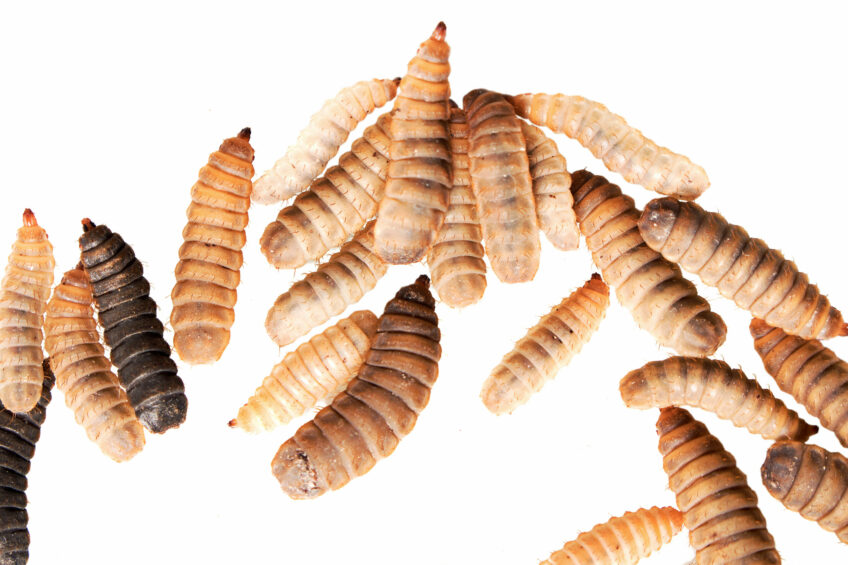
How safe would it be to use insect farming as a potential solution for processing livestock waste? To that end, UK-based researchers have explored the use of Black Soldier Fly larvae to treat pig (and chicken) waste. The study focused on microbial safety, resistance gene transfer and heavy metal risks.
The researchers, attached to the University of Leeds as well as the insect farming technology company Entocycle, have published about their results in the peer-reviewed journal Waste Management.
Using insects for waste
Painting a background picture, the researchers wrote that increasing global demand for food is driving the need to reduce waste produced by agriculture to minimise environmental impacts. The team pointed to the well-known Black Soldier Fly (Hermetia illucens) which is able to reduce livestock waste, but more research into the safety and scalability of the system would be required, they wrote.
How were insects studied?
The team carried out research in semi-commercial and lab-scale scenarios. In the first environment, a semi-commercial-sized insect rearing facility was used to rear larvae on pig slurry, alongside a lab-based experiment using chicken manure.
Larval microbiome composition was impacted by substrate, with increased Clostridia in larvae reared on slurry and manure. Pathogens largely decreased in the larvae from starting levels.
Both slurry and manure substrates showed time-related changes regardless of insect presence or absence except for E. coli in chicken manure which was reduced in substrates with larvae added, suggesting that time-associated alterations in the substrate could be more significant than larval presence.
Potential risks from using insects
Antimicrobial resistance gene changes were dependent on the substrate and gene. In pig slurry-reared larvae, an antimicirobial resistance gene called “tetM” decreased, but there was no difference in another antimicrobial resistance gene called “sul2.” In chicken manure, increases were found for tetM after larval bioconversion and for sul2 in larvae reared on chicken manure.
Heavy metal contents generally met permissible standards for animal feed and organic fertilisers. However, there was some non-significant evidence for bioaccumulation of cadmium in slurry-reared larvae 0.18 to 0.70 mg/kg) compared to starter larvae (0.25mg/kg) requiring further study.