Richard Maatman (Hendrix Genetics): ‘Our impact carries great responsibility’
Hendrix Genetics aims to become the number one or two in every animal species with which it is active. The recent acquisition of Danish Genetics underscores that ambition. Capital is available for acquisitions.
About 15% of the world’s pork is produced by pigs originating from Hendrix Genetics’ breeding programmes. For eggs, this is nearly 50%, and for trout 25%. “We therefore have a significant impact on the world and carry great responsibility,” says the company’s CEO Richard Maatman. “We are an innovative, value-added business, operating globally and playing a crucial role for our customers.”
“We are active in turkeys, laying hens, pigs, salmon, trout, shrimp and traditional poultry genetics. Each species is a business unit, except for salmon and trout, which share a unit because of biological and customer overlap. In breeding you need critical mass to cover R&D costs and to maintain strong product development. Those costs are very high regardless of turnover. In fact, if you sell less, you must invest proportionally more to close the gap in order not to fall behind competitors. You can reach this critical mass either by generating huge turnover in one species or by being active in multiple species. The techniques and models apply across species.
The second reason is spreading risk. If customer earnings are under pressure, genetics companies also suffer – especially if they only deal with one species. That’s reflected in our portfolio: some sectors are performing excellently, others less so.”
“In 2024 it was €642 million. With the recent acquisition of Danish Genetics it is heading towards €800 million. Layers and turkeys each account for slightly more than one-third of the turnover. For pigs, this is around 20%, and salmon, trout and shrimp together just under 10%. Traditional poultry for niche markets in Southeast Asia and Africa makes up a few percent. But turnover isn’t everything. Profitability depends on position in the value chain, product quality, market share, market access and supply-chain robustness. In salmon, trout and shrimp, we operate at the very top of the pyramid, supplying brood stock. In poultry, we supply commercial birds in some regions. This represents much larger cash flows with significantly lower margins.”
In pigs, we are currently number 3 globally
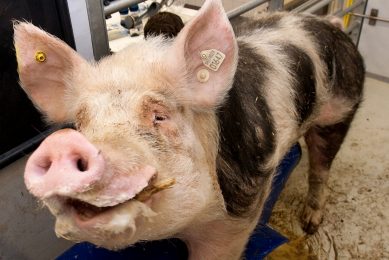
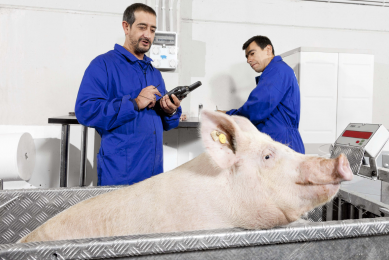
“We ultimately want to be number 1 or 2 in every species we are active in. In laying hens and turkeys, we already hold that position. In pigs, we are currently number 3 globally. In salmon, we are close to the top, excluding Norway, where market restrictions limit growth. In trout, we are market leader. In shrimp, we are among the leading companies. It’s a fragmented market with opportunities for consolidation.”
“In terms of percentages, it’s a 2-digit figure. And it is growing both as a percentage and in absolute value.”
“I can’t give you exact figures – that is confidential information. I think I’m already giving you quite a lot of information.”
 In what region do you see growth potential?
“Historically, we are rooted in Europe, but in recent years we’ve invested in expansion, acquisitions and partnerships in markets with the greatest growth potential. Half of the world’s pigs and a quarter of its chickens are produced in China. We lacked the necessary infrastructure to be competitive there. That’s why, a few years ago, we launched our ‘In China for China’ strategy, creating joint ventures with local partners to strengthen marketing and market access. We’re doing this for layers and slower-growing broilers – our Sasso lines. Our pigs and shrimp businesses are following suit.”
“In Europe, these techniques are not permitted in animals. But things are changing. Several countries consider gene-edited pigs to be safe to eat. PIC recently received approval in the United States for pigs that have been made PRRS-resistant through gene editing. Brazil may allow them, China will follow, and probably several more countries. Gene editing makes traits that are difficult to address through traditional breeding more quickly accessible, such as disease resistance and welfare traits. At the moment, we do not apply it in commercial products. But if gene editing enables such solutions, we must consider it.”
“It can, but every additional technique follows the law of diminishing returns. Feed efficiency can be steered very well with traditional breeding. Maybe there’s only 30% to gain there. In behaviour, there’s still 85% to gain, in health up to 99%. So I expect first applications in those areas. People will also be more enthusiastic about chickens resistant to avian influenza than about better feed conversion.”
“Yes, that’s how I expect it will develop. If an avian-influenza-resistant chicken is accepted worldwide and, after a few years, nothing strange has happened – such as cross-overs people fear – then the threshold for approving editing for feed-conversion improvement becomes lower, and there is an immediate return for farmers. Or you develop a chicken that behaves better in alternative systems. That’s also an advantage.
Believe me, gene editing is the most controversial topic, internally. Not because of technical issues, but because of feelings – people feel you shouldn’t alter the essence of an animal. We are making the first step in the chain. If you change something at the top, you ultimately introduce that change to millions of chickens, with a potential impact on the entire food supply.”
Our in-house knowledge and expertise is complemented with a plethora of expertise from outside players
“Yes. Half the shares are owned by the 2 founders, and I don’t think they plan to step back. A second reason we remain in Boxmeer is the ecosystem of technologically innovative companies – the Silicon Valley of agribusiness around us. Our in-house knowledge and expertise is complemented with a plethora of expertise from outside players. We collaborate with universities and with other breeders, such as cattle-breeding organisation CRV, seed company Rijk Zwaan, and pig-breeding company Topigs (Norsvin, ed.) in so-called pre-competitive areas. Where are the world’s top three in genetics, hatcheries, housing systems, climate control, greenhouse construction located? All within 400 km of Boxmeer. That’s not a coincidence but the result of a long-standing culture of cooperation among government, education and businesses. It’s all interconnected and needs to be fostered. The FAO fears this ecosystem is under pressure – so much so that global food security for the 2 billion people joining us in the coming decades may be at risk.”
“That’s true, but Europe remains an important food producer. You need both critical mass and a market in which to test your product. We are a global player with two kinds of R&D. The first develops fundamental new techniques; the second focuses on application in animals.
Fundamental research is in Boxmeer, the Netherlands. Applied R&D for poultry is largely in the Netherlands and France; for turkeys it is in Canada and France. Swine research is taking place in Denmark, Canada, France, Spain, Germany and China; for salmonids, this is in Chile and Scotland, for trout in the United States, and for shrimp in Hawaii because they require water of 28 °C. Only if another region would develop a stronger ecosystem than the current one would we reconsider our base.
We are now active in China with chickens and pigs, responding to demand for tailored solutions, i.e. locally tested and produced animals supported by expertise from our headquarters in the Netherlands and France. As markets evolve, critical mass can shift. This approach ensures that regional units remain closely connected to the foundation. The same applies to pigs and other species: more regional units mean greater reach, but always as complementary additions, not replacements.”
“I believe the future of genetics is multi-species. EW Group, Hendrix Genetics and Genus can spread R&D costs across several species and develop new techniques. That drives consolidation. That doesn’t mean there will be no smaller niche players — they will remain. But, in general, we see consolidation. In some species, such as chickens and turkeys, consolidation is already far advanced. In pigs, there is much more capital embedded in the animal itself, requiring large investments to consolidate. But I see no reason why pigs won’t be consolidated like poultry.”