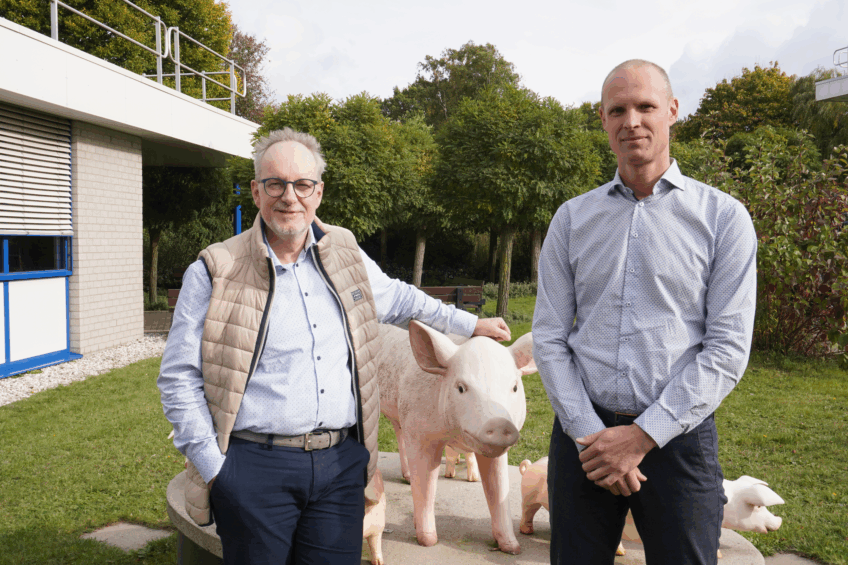
Dr Erwin van den Born and Dr Ruud Segers (MSD Animal Health): ‘Solving the complex puzzle of creating an ASF vaccine’
MSD Animal Health has announced to have made major steps towards the development of a vaccine against African Swine Fever (ASF). And even though it’s too early to say when it can be marketed, first trials and underlying science look positive and hopeful. The lead researchers share which road they took to get there.
When asked to describe that first “eureka moment,” Dr Erwin van den Born smiles and says, “I recall that it was a very happy moment when we were doing safety trials with several vaccine candidates. We decided to include a triple gene deletion mutant in one of our safety trials. While other vaccine candidates failed to meet our safety criteria, it turned out to be safe as the vaccinated piglets stayed healthy and were protected. That was when we knew we had an effective screening pipeline for vaccine safety, and that we could be onto something.”
Triple gene deletion
What exactly is a triple gene deletion mutant and why this was such a joyful moment will be explained below. Dr Van den Born is senior project leader R&D swine biologicals at MSD Animal Health – and as such in charge of the company’s ASF project. In his research he is supported by Dr Ruud Segers, the company’s head of R&D for swine and ruminant biologicals.
Several commercial ASF vaccines are already being marketed and available in Vietnam and the Philippines. Yet the US-based multinational is the first major global pharmaceutical company to announce research results of a promising live vaccine candidate at the upcoming Asian Pig Veterinary Society (APVS) Congress in Fukuoka, Japan.
Whatever we tried in our trials, nothing worked, except live vaccines
ASF: a complex virus
Developing a vaccine against ASF virus has been a long-term process – the company has been working on it since 2018. It is in no way comparable to the development of some other vaccines, both scientists explain. “The ASF virus is tremendously difficult,” Dr Segers explains at the MSD plant in Boxmeer, the Netherlands. “We tested subunit vaccines, we tried vector vaccines, we tested inactivated vaccines and we tested mRNA and DNA based vaccines. Whatever we tried in our trials, nothing worked, except live vaccines.”
He continues to say, “A complicating factor is that the ASF virus has a very large genome, including regions with repetitive genes that are prone to recombination. So the challenge is to find the right genes to delete to attenuate the virus and do it in such a way that the resulting virus remains stable. We are looking for that sweet spot to achieve sufficient safety and stability while remaining protective in pigs.”
And especially safety, both scientists emphasise, has been a priority defining the road the MSD team took. A true vaccine candidate had to be safe and stable in piglets but also in the most vulnerable of pigs: pregnant sows. Working with ASF means working with stringent hygiene measures in high containment facilities and compliance with many regulations and paperwork. Dr Van den Born grins and says, “It was not an easy journey as we faced many technical and administrative issues to arrive where we are now.”
Licensed-in candidates as basis
Just like some of the current Vietnamese vaccines, the MSD team started-off working with vaccine candidate strains that were licensed-in.* Assessing the stability of a vaccine candidate can be done via so-called “reversion-to-virulence” trials. Key question there is: does a vaccine candidate remain attenuated upon passaging in animals, or will it gain virulence?
European legislation dictates that this type of mandatory stability trials must be done using five subsequent “passages” of infections. In the Netherlands, these have taken place in a Biosafety Level 3 animal facility in Lelystad. A first “passage” of three pigs received the vaccine candidate via injections, subsequently a second group of three received virus-containing blood of the first set – and so on until a fifth and final group of ten animals also went through that phase.
Dr Van den Born says, “If the vaccine candidate is stable, you will see no difference in clinical signs during the first and the fifth animal passage. And not only phenotypically, but also genotypically you want to see stability as can be demonstrated by full genome sequencing.” He adds “several vaccine candidates showed reversion to virulence and were therefore not selected for product development.”
No return to virulence
Return to virulence, however, was something that did not happen with the vaccine candidate which MSD is now upbeat about. This is a licenced-in vaccine candidate which already had two gene deletions, which explains the use of the delta (Δ) in the name: Δ9GL and ΔUK but now with an added third deletion. Dr Van den Born therefore calls it a “triple gene deletion mutant.” He says, “We tried a couple of candidates, and eventually we opted for a third deletion called ΔEP153R.”
After construction of the final strain with three attenuating gene deletions, the safety testing in animals was completed to satisfaction. A further benefit of the third gene deletion was there are now three opportunities to develop diagnostics that can differentiate between the vaccine strain and circulating wild-type virus.
Obviously it all depends on where we were having the right contacts to do field trials and where the largest problems are with regards to commercial swine farms
Testing in the field
Having found a secure vaccine candidate, that passed all the safety screenings is just a first step. The safety testing in high containment conditions can only be performed on relatively small numbers of healthy animals. The second step is testing under field conditions. To that end, the MSD team is testing their vaccine candidate in the Philippines. Dr Van den Born points out that this is a logical place to start the trials, “Obviously it all depends on where we were having the right contacts to do field trials and where the largest problems are with regards to commercial swine farms.”
He continues to say, “In collaboration with the government in the Philippines, we have finalised a test with a ten-fold overdose of the vaccine candidate in a limited number of piglets and non-pregnant gilts without the occurrence of clinical disease. Subsequently, we are conducting a larger trial involving 537 piglets and 76 pregnant sows covering each of the three trimesters, spread out over 4 farms.”
Dr van den Born says, “Also this study is blinded, so we had no idea which animals had been vaccinated and which hadnot.” At the moment of publication of this article, it was too early to share the outcome, as the researchers are still processing thousands of samples from the trial and then have to interpret the results.
Next steps
The million dollar question is always: when is the vaccine going to be commercially available? Both experts are quick to dismiss that question as premature. The ASF situation is sensitive and in various countries a matter of national importance and governance.
Dr Segers says, “On the basis of everything we have seen, we hope the vaccine candidate will offer solid protection. In addition to further testing under field conditions, the next step is to scale up and be able to produce GMP-grade vaccine and apply for an EU license.”
Dr Van den Born: “That was another one of those eureka moments when we found a way to culture the vaccine in a clean and controlled cell line rather than in freshly isolated swine macrophages.”
He continues to say, “There is a huge team behind this project and we are fortunate to have experts from different disciplines like biotechnology, regulatory affairs, molecular genetics, intellectual property and many more in the team. Also the team has been working in and traveling between the Netherlands, Germany, Hungary and Philippines. We’re starting to get near the end goal for which we have been doing all those trials. I’m very proud of this – to potentially have solved this complex puzzle.”
Gathering data
Dr Segers is more modest when concluding, “All in all, there has not been one particular moment in which I had the feeling: yes, we are there, because with a project like this, there is usually still a next issue to solve. As opposed to a normal project, for the sake of speed to market for an ASF solution, we took the approach to perform a lot of activities at risk in parallel. We have achieved a lot but are still in the middle gathering data – the “hurrah” moment will come when we have the first batch of licensed vaccine that can be shipped to help our customers in protecting their animals. Now that is going to be a superb moment, and we are hopeful that moment will come.”
Join 18,000+ subscribers
Subscribe to our newsletter to stay updated about all the need-to-know content in the pigsector, three times a week.